
What Is a Solar Mini UPS? Complete Guide to 55W Solar UPS for Home, WiFi & Emergency Backup
What Is a Solar Mini UPS? Complete Guide to 55W Solar UPS for Home, WiFi & Emergency Backup
- Luxntek
What Is a Solar Mini UPS?
Power cuts can interrupt WiFi connectivity, home lighting, mobile charging and other essential low-power devices. A solar mini UPS provides a compact way to keep selected devices running when grid electricity is unavailable.
Unlike a conventional large home inverter system, a mini solar UPS is designed for essential low-power backup applications. Depending on the model and connected load, it can be used for devices such as WiFi routers, LED lights, compatible 12V DC fans and USB devices.
In this guide, we explain what a solar mini UPS is, how it works, what you can power with a 55W system, how solar charging works and how to choose the right solar UPS for your requirements.
How Does a Solar Mini UPS Work?
The basic operating principle is simple:
Solar Panel → Charging System → Battery → UPS → Connected Devices
During the day, a compatible solar panel supplies energy to the charging circuit. The charging system stores that energy in the battery.
When electricity is available, the system can also use AC/grid power for charging if supported.
During a power cut, stored battery energy is supplied to the connected devices.
For example:
☀️ Solar Panel
↓
Battery
↓
⚡ Solar Mini UPS
↓
WiFi Router | LED Light | 12V DC Fan | USB Device
Why Use a Solar Mini UPS?
A conventional home inverter is designed to handle substantially larger loads. But not every application requires a large inverter.
If you only need backup for a WiFi router, LED lighting, USB charging or a small DC appliance, a compact solar UPS may be a more practical solution.
Compact Design
A mini UPS takes considerably less space than a conventional inverter and external battery setup, making it suitable for homes, shops and small offices.
Solar Charging
Solar charging can help reduce dependence on grid electricity for recharging, provided the solar panel and charging input are correctly matched.
Lithium Battery
A lithium battery provides a compact energy-storage solution with a high energy-to-weight ratio and is well suited to portable and compact backup systems.
Essential Backup
A small UPS can keep important low-power devices running during electricity interruptions.
Easy Installation
Many mini UPS products are designed for plug-and-play or DIY installation, making them convenient for everyday backup requirements.
What Can a 55W Solar UPS Power?
A 55W solar UPS is intended for low-power devices. The actual suitability depends on the voltage, current and power requirements of the connected device.
| Device | Typical Use |
|---|---|
| WiFi Router | Internet backup |
| LED Bulb | Emergency lighting |
| USB Device | Charging compatible devices |
| 12V DC Fan | Cooling during outages |
| Emergency LED | Backup illumination |
| Small DC Devices | Low-power applications |
Important: The connected device must be compatible with the UPS's specified output voltage, current and maximum power.
A 55W UPS should not be treated as a replacement for a high-capacity household inverter. High-power appliances such as air conditioners, refrigerators, water heaters and large appliances generally require substantially more power.
Solar UPS for WiFi Router Backup
One of the most useful applications of a mini UPS is WiFi router backup.
During a power cut, your router may stop working even when your smartphone or laptop still has battery power. A backup UPS can keep the router powered, allowing your internet connection to remain available as long as the internet service provider's network and other required equipment are also operational.
Before connecting a router, check the specifications printed on its power adapter.
Look for:
- Output voltage
- Current requirement
- Polarity
- Connector type
- Total power consumption
Never connect a device simply because its connector physically fits. Always verify electrical compatibility before connecting the device.
How Long Will a Solar UPS Run a WiFi Router?
Backup time depends primarily on:
- Battery voltage
- Battery capacity
- Router power consumption
- Conversion efficiency
- Battery condition
- Temperature
- Other connected loads
A router consuming 5W will generally require much less energy than a 20W load. Therefore, lower power consumption generally results in longer backup time.
Any advertised backup time should be considered an up-to figure unless the exact test conditions are specified.
For the LUXNTEK 55W Solar Mini UPS, actual runtime depends on the connected load and operating conditions.
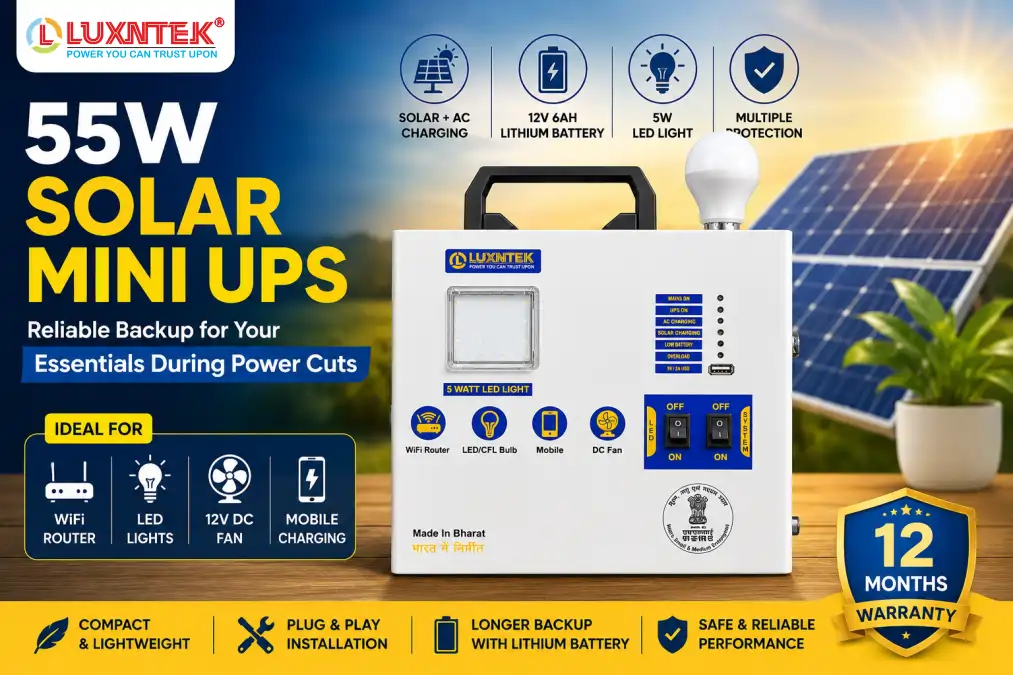
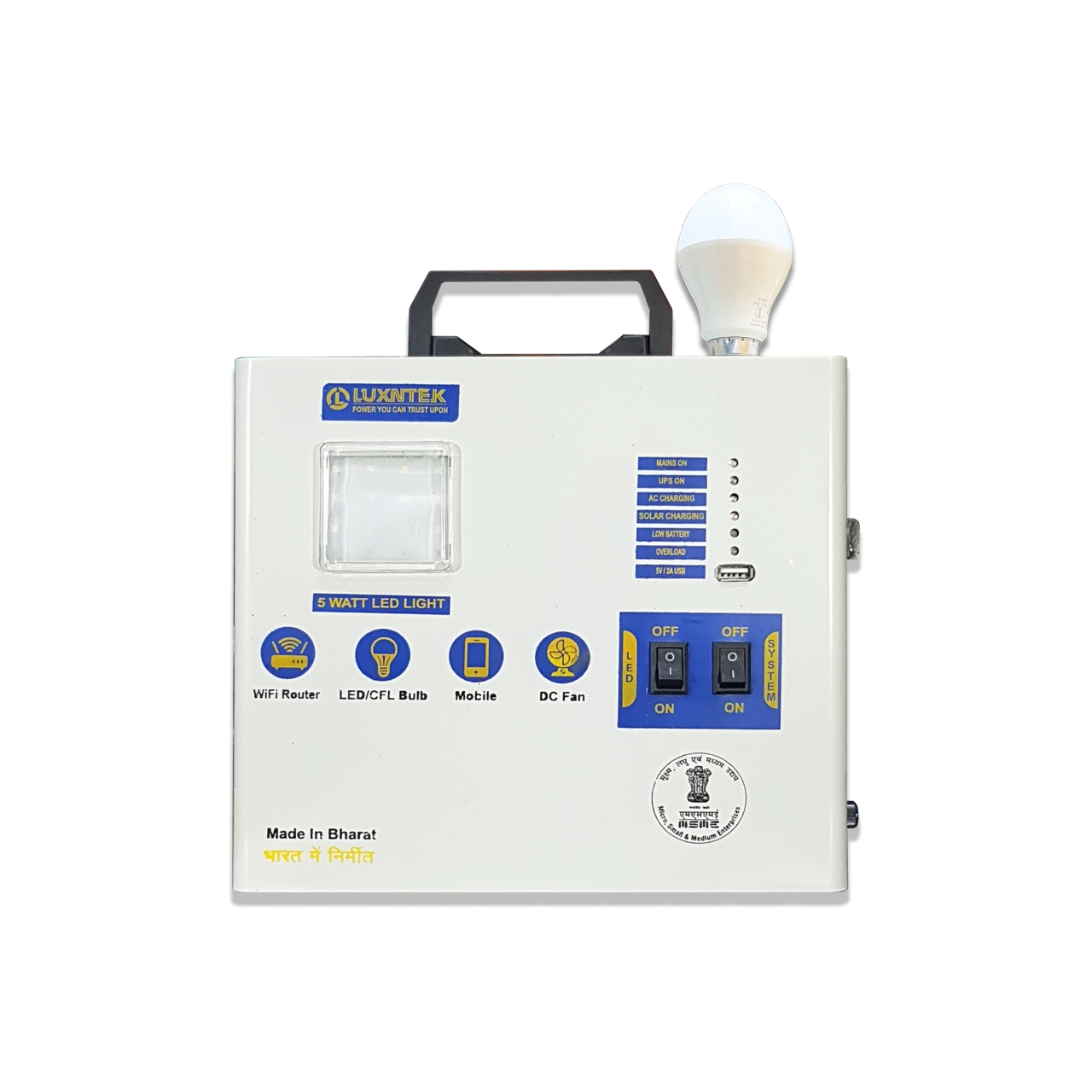
LUXNTEK 55W Solar Mini UPS with Lithium Battery
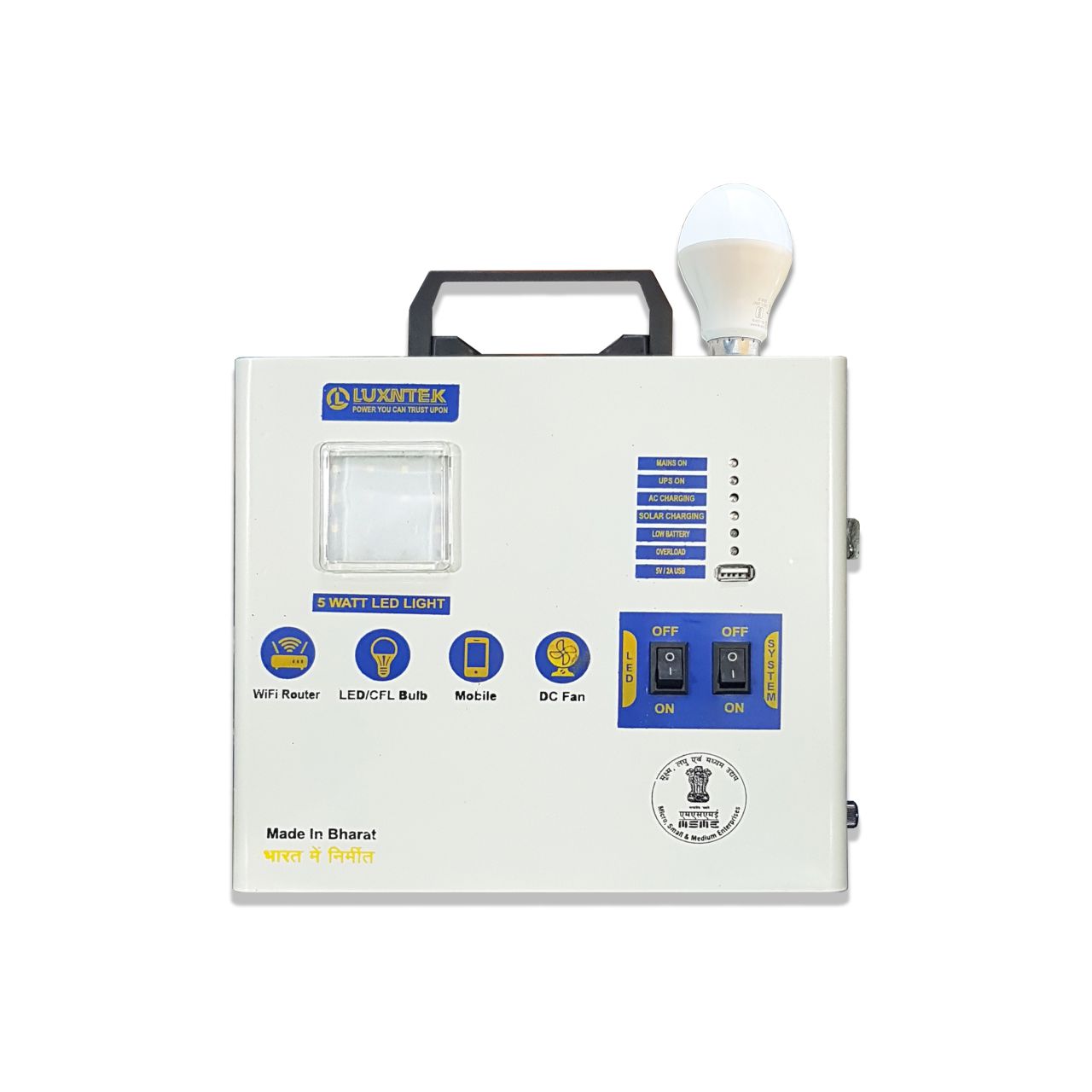
For users looking for a compact solar backup solution, the LUXNTEK 55W Solar Mini UPS Inverter combines a 12V 6Ah lithium battery with solar and AC/grid charging.
It is designed for applications including:
- WiFi router backup
- Emergency LED lighting
- Compatible 12V DC fan backup
- USB/mobile charging
- Small low-power devices
- Home emergency backup
- Shop and office backup
Key Features
- 55W Output: Designed for essential low-power backup applications.
- 12V 6Ah Lithium Battery: Provides energy storage in a compact package.
- Solar + AC Charging: Supports flexible recharging using the supported charging inputs.
- 5W Emergency LED: Provides convenient emergency lighting.
- 5V/2A USB Output: For compatible USB devices.
- 12V DC Output: For compatible DC appliances within the specified limits.
- Compact Design: Suitable for homes, shops and offices.
- Protection Features: Includes protection against overload, short circuit, low battery and overcharging.
Solar Mini UPS vs Conventional Inverter
| Requirement | Solar Mini UPS | Conventional Home Inverter |
|---|---|---|
| WiFi Router | Excellent | Often unnecessary |
| LED Lighting | Suitable | Suitable |
| USB Charging | Suitable on supported models | Depends on system |
| Small DC Fan | Suitable if compatible | Suitable |
| Refrigerator | Not suitable | Suitable with correct capacity |
| Air Conditioner | Not suitable | Requires high-capacity system |
| Multiple Appliances | Limited | Better suited |
| Space Required | Low | Higher |
| Solar Charging | Available on supported models | Depends on model |
How to Choose the Right Solar Mini UPS
1. Check Your Load
Calculate the total power consumption of the devices you want to connect.
For example:
Router = 10W
LED = 5W
USB device = 5W
Total = 20W
A 55W system may have sufficient rated output for this example, provided all voltage and connection requirements are compatible.
2. Check Battery Capacity
Battery capacity determines how much energy can be stored.
The LUXNTEK 55W Solar Mini UPS uses a 12V 6Ah lithium battery.
Nominal stored energy can be estimated as:
12V × 6Ah = 72Wh
Actual usable output energy will be lower than the nominal figure because of conversion losses, battery-management limits and operating conditions.
3. Check Output Voltage
This is especially important when powering DC devices. A 12V DC appliance should be connected only to an output designed to provide the appropriate voltage and current.
4. Check Solar Input Specifications
Do not select a solar panel based only on wattage. Check the UPS manufacturer's specified solar input voltage, maximum solar voltage, recommended panel wattage, charging current and connector requirements.
5. Check Safety Features
Look for protection against conditions such as overload, short circuit, overcharging and low battery/deep discharge.
Solar UPS for Home Lighting
A compact solar UPS can be useful for emergency lighting. During a power cut, essential LED lights can provide illumination without requiring a large inverter system.
For homes, shops and small offices, a system with a built-in emergency LED can provide convenient lighting whenever grid power is unavailable.
Solar UPS for Shops and Small Offices
Power interruptions can affect WiFi connectivity, billing systems, networking equipment, emergency lighting and mobile charging.
A compact UPS can provide targeted backup without running an entire office through a large inverter system.
Common Mistakes When Buying a Solar Mini UPS
Mistake 1: Looking Only at Wattage
A higher wattage number does not automatically mean the UPS is suitable for your device. Voltage and current compatibility are equally important.
Mistake 2: Ignoring Router Specifications
Always check the router adapter before purchasing a router UPS.
Mistake 3: Choosing an Incorrect Solar Panel
The solar panel must match the UPS's solar input specifications.
Mistake 4: Expecting Unlimited Backup
Battery capacity is limited. Connecting more devices increases energy consumption and reduces runtime.
Mistake 5: Using High-Power Appliances
A 55W mini UPS is not intended for high-power appliances such as refrigerators, air conditioners or heaters.
Frequently Asked Questions
Is a solar mini UPS useful during power cuts?
Yes. It can provide battery backup to compatible low-power devices when the main electricity supply is unavailable.
Can I use a solar mini UPS for my WiFi router?
Yes, provided the router's voltage, current, polarity and power requirements are compatible with the UPS output.
Can a 55W solar UPS run a fan?
It can run a compatible 12V DC fan if the fan's power requirement is within the UPS's output limits.
Can I charge my phone with a solar UPS?
A UPS with a suitable USB output can charge compatible USB devices. The LUXNTEK 55W model provides a 5V/2A USB output.
Can a 55W solar UPS run a refrigerator?
No. Refrigerators generally require substantially more power and can also have higher starting-power requirements. A properly sized high-capacity inverter system should be used instead.
Does solar charging work at night?
No. Solar panels require sunlight to generate power. At night, the UPS relies on stored battery energy or another supported charging source.
How long does a solar UPS battery last?
Battery life depends on battery chemistry, charging cycles, depth of discharge, temperature, usage and maintenance. Following the manufacturer's charging and operating recommendations can help maximize battery life.
Is a solar UPS better than a normal UPS?
It depends on your requirements. A solar UPS provides the additional advantage of solar charging, while a conventional UPS may be sufficient where solar charging is not required.
Conclusion
A solar mini UPS is a practical solution when you need backup power for essential low-power devices without installing a large inverter system.
For applications such as WiFi router backup, emergency LED lighting, USB charging and compatible 12V DC devices, a compact 55W solar UPS can provide a convenient combination of battery backup and solar charging.
Before purchasing, always check your device's voltage, current and power requirements, as well as the UPS's battery capacity, output limits and solar input specifications.
For users looking for a compact solution, the LUXNTEK 55W Solar Mini UPS with 12V 6Ah lithium battery is designed for everyday low-power backup applications, with solar and AC/grid charging, emergency LED lighting, USB charging and 12V DC output.
Looking for Compact Solar Backup?
Explore the LUXNTEK 55W Solar Mini UPS Inverter
Actual backup time depends on connected load, battery condition, operating conditions and other factors. Always verify device compatibility and solar input specifications before connection.
0 Comments
No approved comments yet.